
Share
1. The age the door closes
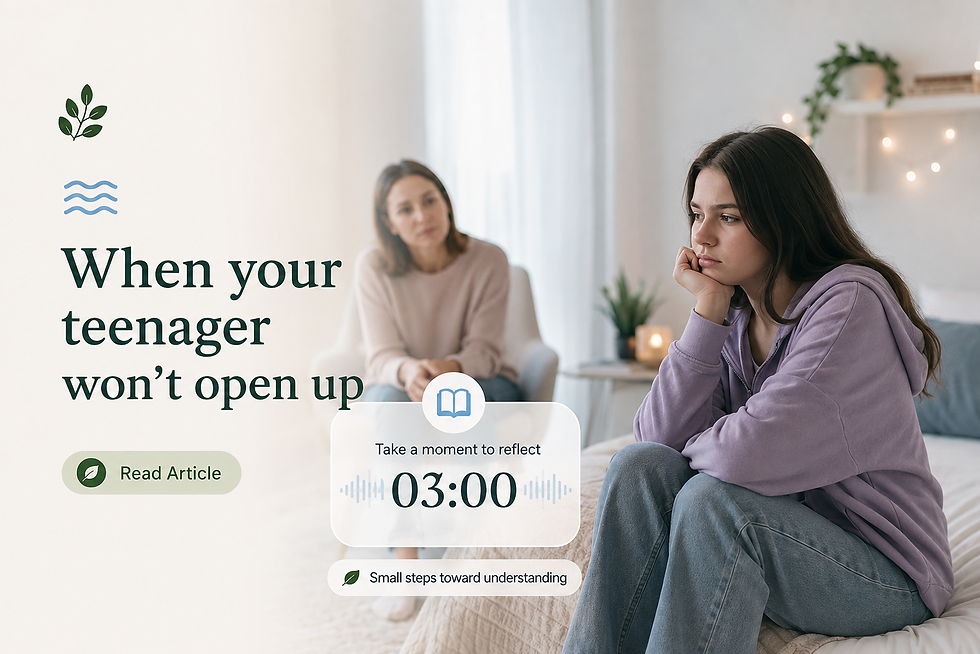
Parents of teenagers will recognise the experience: the open child you used to know, the one who told you everything, becomes a teenager and a door closes. They retreat to their room. They give one-word answers. They show you a face that you cannot fully read.
This is not personal. This is development. The job of adolescence is, in part, to establish a self that is not just the parent's self. Withdrawal is a feature of that work — not a failure of the relationship.
But sometimes the withdrawal is more than developmental. Sometimes it is a signal. This article walks the difference, and what to do.
2. What is happening in a teenage brain
The teenage brain is in active reorganisation. The amygdala (the part of the brain that scans for danger) is fully online by mid-childhood. The prefrontal cortex (the part that does emotional regulation, perspective-taking, and impulse control) does not finish developing until the mid-twenties.
This means teenagers feel emotions intensely — and have less internal apparatus to regulate them. A teenager who seems disproportionate is not being dramatic. They are doing the best regulation a not-yet-finished brain can do.
3. The principle — be a safe harbour, not an interrogator
The single most powerful thing you can offer a teenager is steady availability. Not constant questioning. Not eagerness to fix. Steady availability.
What this looks like in practice:
· Be physically nearby in low-stakes moments. The car, the kitchen, the walk to the corner shop. Side-by-side conversations are easier than face-to-face.
· Ask less. Notice more. 'Are you okay?' lands as pressure. 'You seem quiet today' lands as observation.
· Wait for the door to open. It often opens at unpredictable moments — 11pm, the drive home from sport, halfway through a film.
· When the door opens, do not flood the gap. Listen more than you respond.
· Resist solving. Most of the time, teenagers open up to be heard, not to be fixed.
4. Specific things that help
· Eat together where possible. A meal with no agenda, three times a week, builds more than five planned conversations.
· Notice their world. Their music, their friends' names, the show they are watching. Showing curiosity about their world is the warmest invitation you can issue.
· Make non-verbal repair available. A hand on the shoulder. A meal left at the door. A note. Adolescents often accept warmth they cannot accept in words.
· Tell them about you. Not what they should do. What you actually do when you struggle. Modelling vulnerability earns it.
· Have one trusted other adult in their life — an aunt, an uncle, a family friend, a teacher. Sometimes the adolescent will speak to that person before they speak to you. That is not a failure of your relationship.
5. The signs that it is more than development
Some withdrawal patterns are clinical, not developmental. Be attentive to:
· A sustained drop in sleep or sleep quality — more than two weeks.
· A sustained drop in eating, or marked changes in eating patterns.
· Stopping things they used to love — sport, music, friends — and not replacing with anything.
· Self-isolating to a degree that worries them as well as you.
· Talk of self-harm, not wanting to be here, or wanting to die. Even one mention requires immediate clinical contact.
· New use of substances — alcohol, vaping, cannabis, prescription medication.
· A sudden change in friend group, with new contacts you cannot meet.
If you are seeing two or more of these, do not wait. Speak to your GP this week. A teenager's clinical pattern that starts at 14 is very different from one that starts at 17.
6. How to ask for help — with the teenager, not despite them
Teenagers respond badly to being talked about. They respond better to being talked with. When it is time to bring a clinician in:
· Tell them. 'I'd like us both to talk to someone. I think it could help.'
· Give them choice. 'Would you rather a male or female clinician?' 'Online or in person?'
· Go first if you can. Modelling clinical help is a powerful gift.
· Be present at the first appointment if they want you, absent if they want you absent.
· Confidentiality matters. In most clinical settings, what a teenager tells the clinician stays with the clinician (within standard safeguarding limits). Tell them this.
7. Where to go next
· Save D-05 — How to sit with an anxious child (works for adolescents too).
· Watch V-06 — How to sit with an anxious child.
· Read A-05 — How to talk to an anxious child, if you are also parenting younger children.
· If you, the parent, are struggling, read A-03 — When self-help is not enough.
Sources
· NICE CG113 — Generalised anxiety disorder and panic disorder in adults: management. https://www.nice.org.uk/guidance/cg113
· NICE CG159 — Social anxiety disorder. https://www.nice.org.uk/guidance/cg159
· WHO mhGAP Intervention Guide, Version 2.0 (2016) + 2023 update. https://www.who.int/publications/i/item/9789241549790
· NICE NG87 — Anxiety in young people quality standard. https://www.nice.org.uk/guidance/qs53
· Rana Heiba — 'Parenting Under Stress' (v1, 21 May 2026).
· Monita Content Guide v1.0 (May 2026) — voice, vocabulary, canonical framings.
KSA MoH crisis line: 920033360 (verified 21 May 2026). GCC numbers beyond KSA remain [TO ALIGN].

